MotionAnymesh: Physics-Grounded Articulation for Simulation-Ready Digital Twins
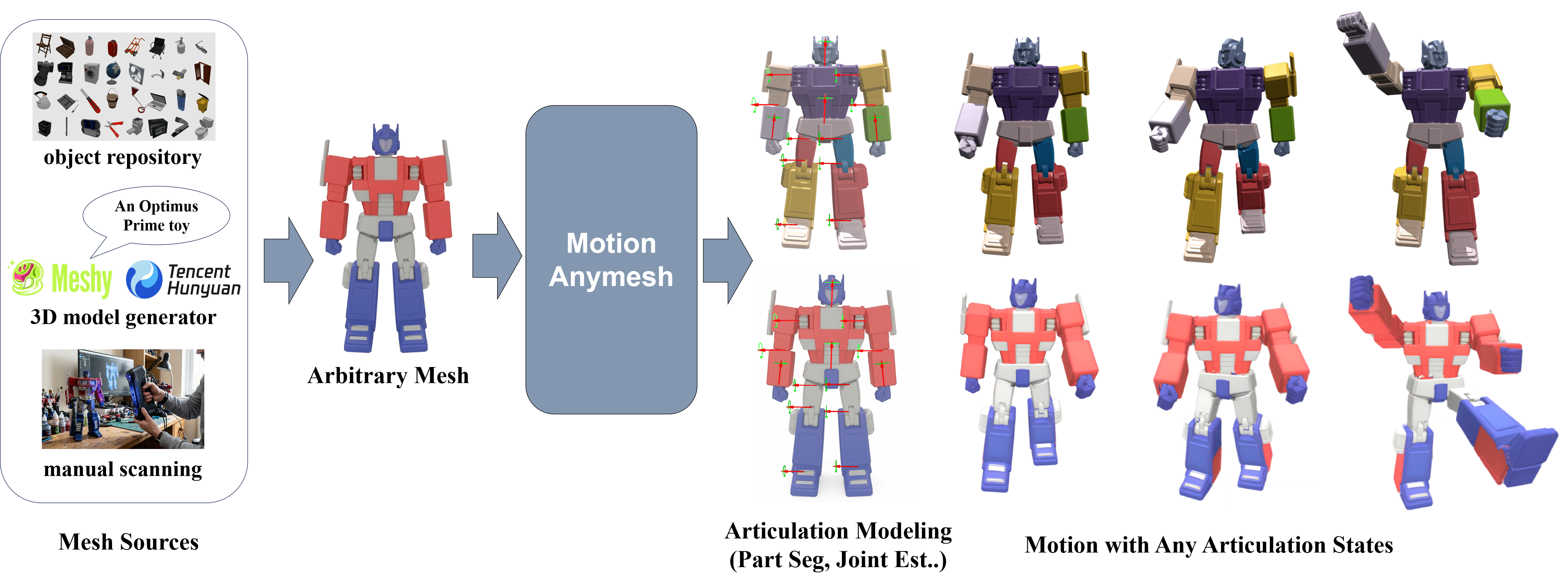
Zero-shot conversion of static 3D meshes into collision-free, simulation-ready articulated URDF digital twins.
Abstract
Converting static 3D meshes into interactable articulated assets is crucial for embodied AI and robotic simulation. Existing zero-shot pipelines struggle with complex assets because ungrounded VLM reasoning can hallucinate kinematic structures, while unconstrained joint estimation often causes severe inter-penetration during simulation.
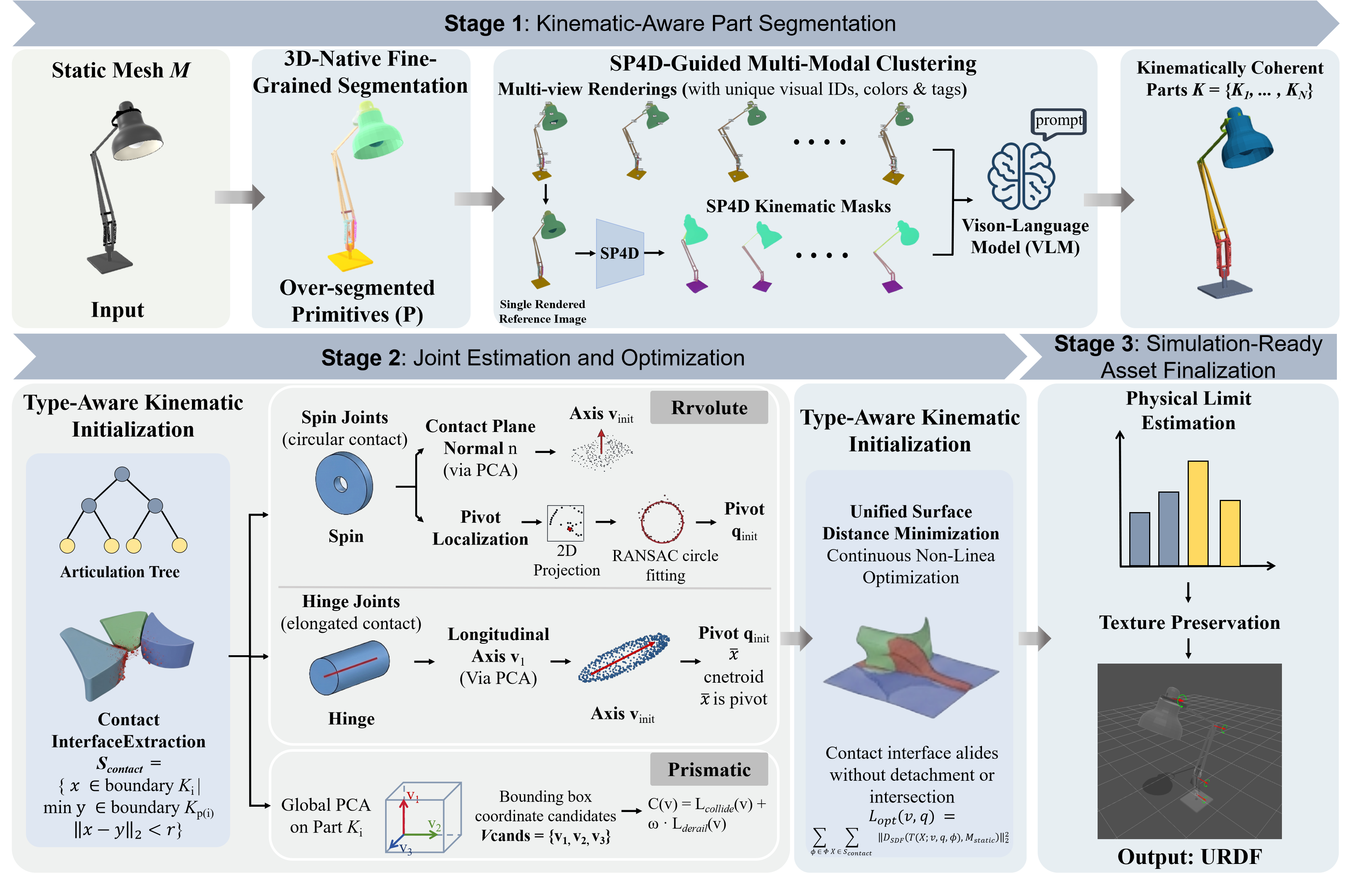
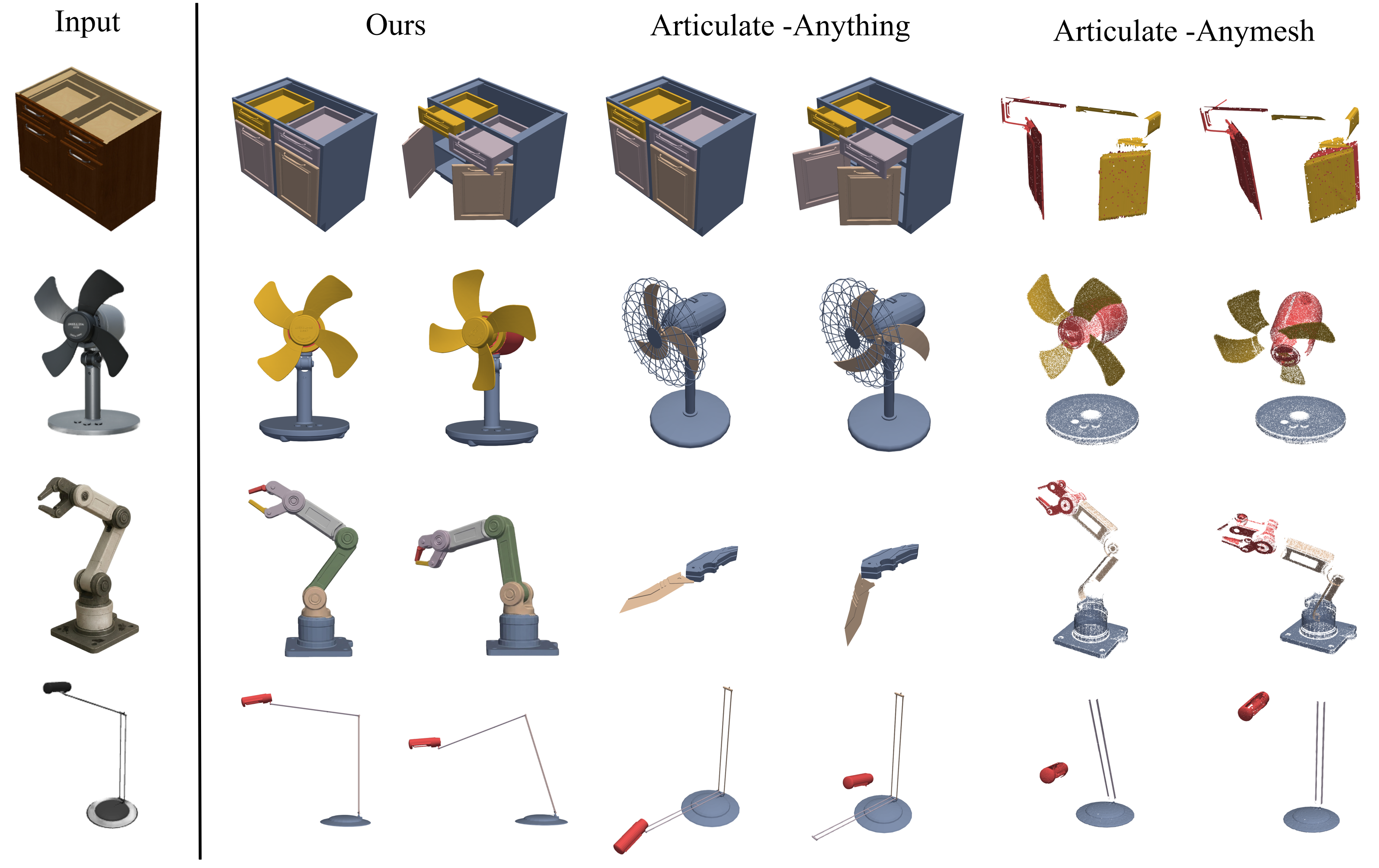
MotionAnymesh is an automated zero-shot framework that transforms unstructured static meshes into simulation-ready digital twins. It combines kinematic-aware part segmentation grounded by SP4D physical priors with geometry-physics joint estimation, including type-aware initialization and physics-constrained trajectory optimization. Extensive experiments show stronger geometric precision and dynamic physical executability than prior baselines.
Highlights
MotionAnymesh addresses the missing physical grounding in existing static-to-articulated pipelines by unifying kinematic-aware perception with physics-constrained actuation.
Kinematics-Grounded 3D Part Segmentation
We decouple physical boundary recovery from semantic grouping: clean 3D-native primitives preserve object geometry, while explicit multi-view kinematic priors guide their assembly into coherent movable parts, suppressing both 2D projection artifacts and VLM kinematic hallucinations.
Geometry-Physics Joint Optimization
We formulate joint estimation as a physically constrained optimization problem: type-aware contact-interface initialization predicts robust axes and pivots, then trajectory refinement penalizes collision, detachment, and micro-misalignment throughout virtual articulation.
Simulation-Ready Digital Twins
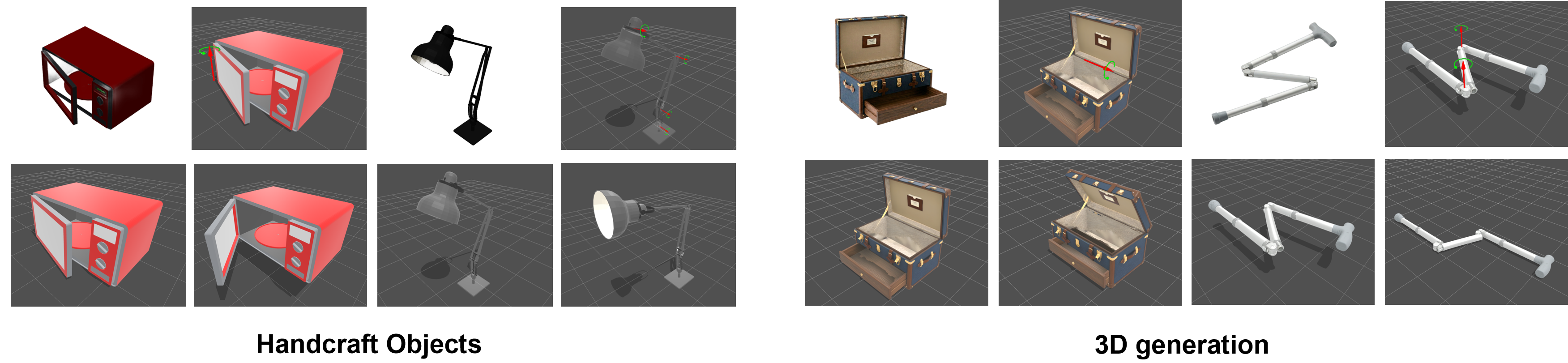
We convert the recovered part hierarchy, optimized joints, motion limits, and preserved textures into standard URDF assets that can be directly executed in physics simulators and used for embodied AI and real-to-sim-to-real robotic workflows.
Method Overview
Qualitative Comparison
Applications

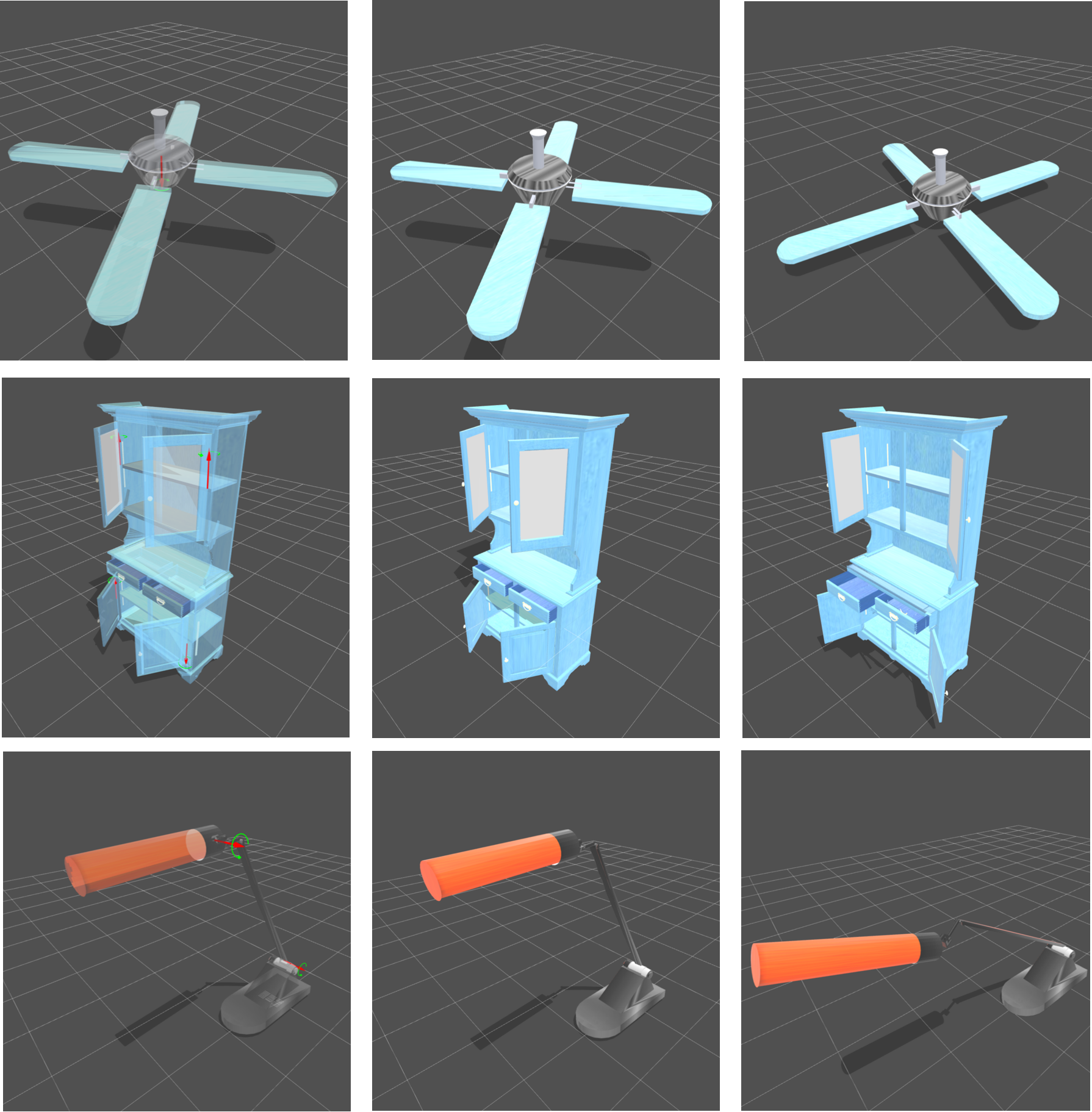
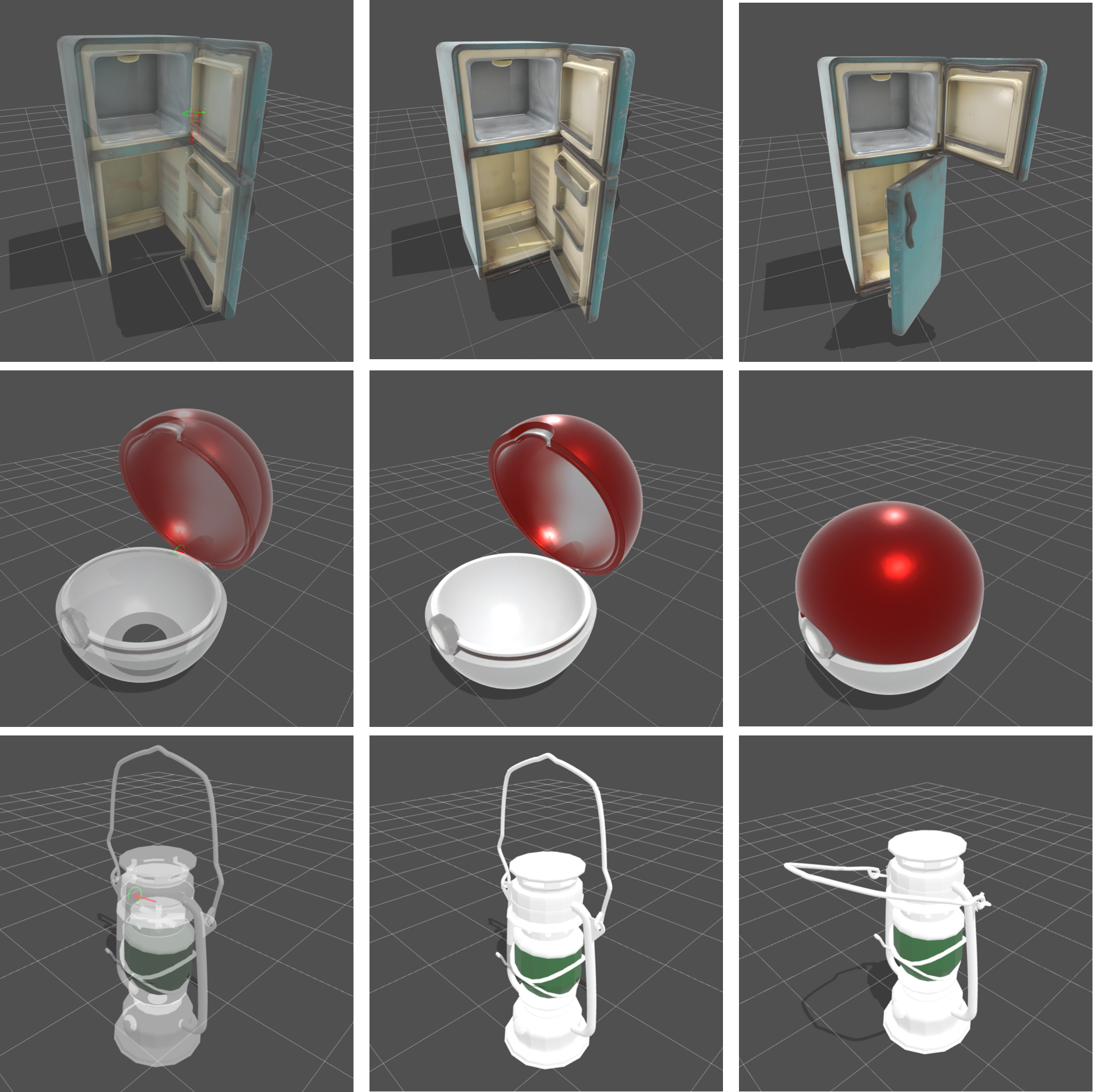
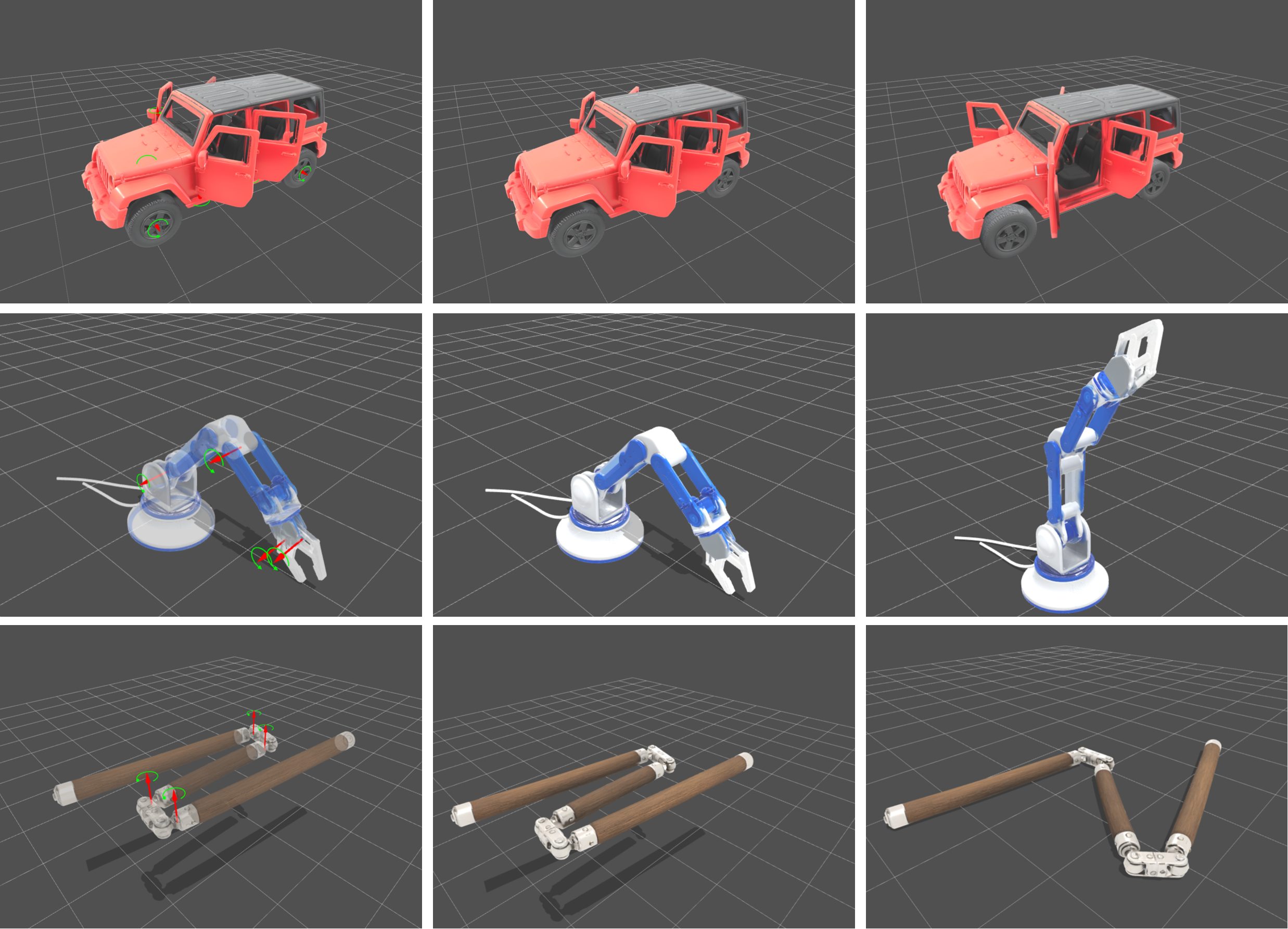
Qulitative Results
BibTeX
@misc{xu2026motionanymeshphysicsgroundedarticulationsimulationready,
      title={MotionAnymesh: Physics-Grounded Articulation for Simulation-Ready Digital Twins},
      author={WenBo Xu and Liu Liu and Li Zhang and Dan Guo and RuoNan Liu},
      year={2026},
      eprint={2603.12936},
      archivePrefix={arXiv},
      primaryClass={cs.RO},
      url={https://arxiv.org/abs/2603.12936},
}